Construction Site Hoarding & Project Fencing in Qatar: Materials, Design and Installation
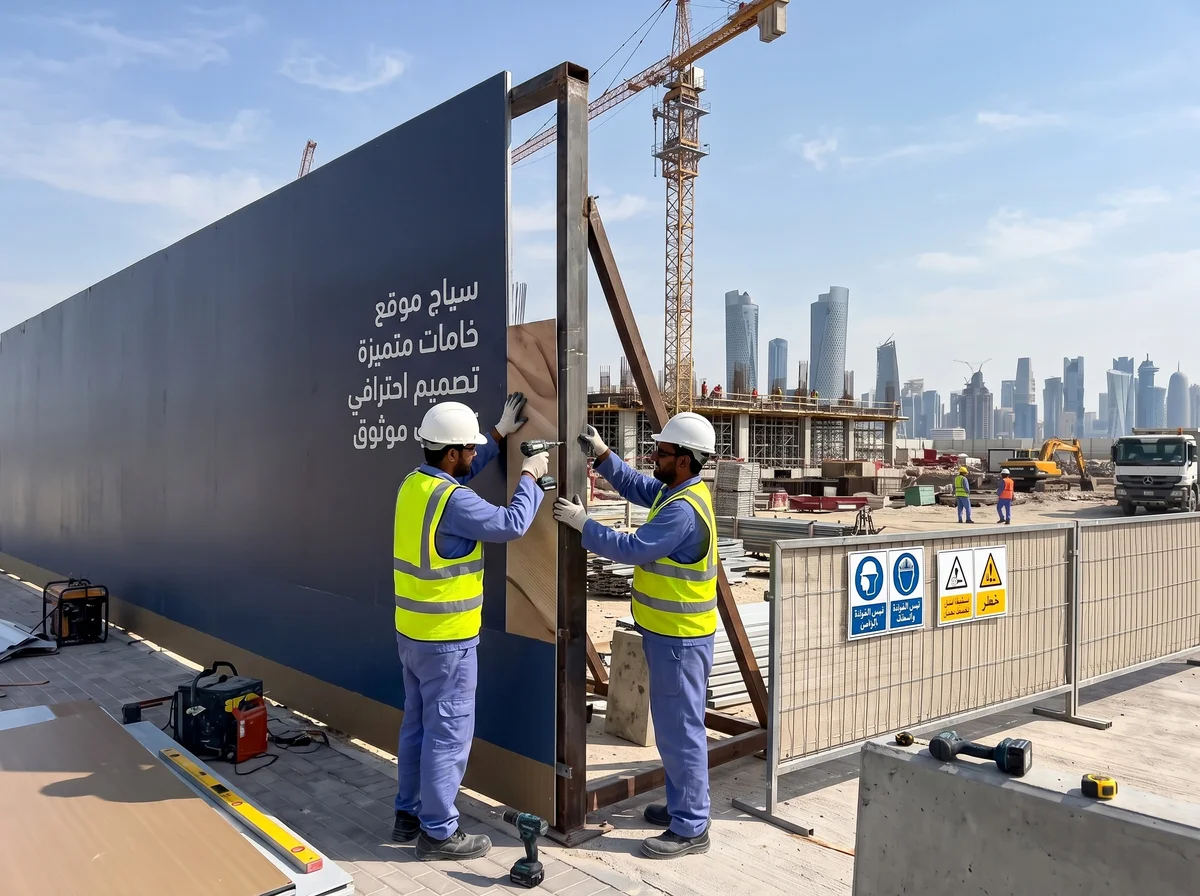
On almost every street in Doha you'll find a construction site wrapped in a printed hoarding carrying the project name and an artist's impression of the building to come. That hoarding isn't just a safety barrier — it's one of the most powerful fixed advertising media in Qatar: a surface stretching tens of metres, seen by thousands of drivers and pedestrians every day, and standing in place for months or even years. In this guide we cover everything you need to know about hoarding panels and construction site fencing in Qatar — from materials and sizes to design, installation and cost.
What Is Hoarding and Why Does It Matter?
Hoarding is the temporary fencing that encloses a construction or renovation site and separates it from its surroundings. Its primary job is safety: keeping unauthorised people out, containing dust and visual clutter, and protecting passers-by from the hazards of the work. But its second function is every bit as important — marketing. The hoarding gives the developer and contractor a permanent display frontage that can showcase:
- The project name, logo and final render.
- Logos of the developer, consultant, contractor and partners.
- Contact details for sales or pre-leasing.
- Mandatory safety and warning signage.
A commercial project in The Pearl, Lusail or Al Wakrah may get more out of a 100-metre hoarding frontage than out of a paid advertising campaign running for several months — provided the design and print quality are up to standard.
Hoarding Panel Materials
1. Coated Metal Panels
This is the most common choice for large, long-term projects in Qatar. Corrugated steel or sandwich panels are fixed to a steel frame and then covered with a printed sticker using UV-resistant inks. They offer excellent durability, stand up to wind and heat, and can be reused on another project by simply changing the print.
2. Flex and Mesh Banners
An economical, fast solution for short-term projects or temporary campaigns. Printed flex is tensioned onto a metal frame with ropes or metal eyelets. Mesh, meanwhile, is a perforated fabric that lets air through, greatly reducing wind load and making it ideal for elevated frontages or scaffolding. Printing here is carried out using large-format printing and advertising signage techniques, with widths up to 5 metres seamlessly.
3. Treated Plywood
Used for interior fit-out and renovation sites inside malls or buildings, where the hoarding is short and sheltered from the weather. It can be painted or covered with a printed sticker for a clean finish that suits a retail environment.
4. Rigid Boards for Detailed Elements
For information panels, gates and partner boards, materials such as Forex, aluminium composite or acrylic are used, as they deliver a more refined look and sharper detail. You can read about the differences between them in our article on Forex and acrylic signage in Qatar.
Standard Sizes and Heights
- Height: 2 to 3 metres, depending on the nature of the site and its proximity to traffic.
- Panel width: 1.2 metres or 2.4 metres — standard sizes that make transport and replacement easier.
- Gates: a pedestrian gate roughly 1 metre wide, and an equipment gate 6 metres wide or more.
- Post spacing: approximately every 2.4 metres, with raking props or concrete bases to resist wind.
Rules for Effective Hoarding Design
Designing for an 80-metre hoarding is completely different from designing a small banner. The key rules:
- Don't repeat the same image every two metres. Break the frontage into "scenes": the project render, then a short message, then logos, then contact details.
- Go very large with type. Make the main headline at least 40 cm tall so it can be read from a car travelling at 60 km/h.
- High colour contrast. Light text on a dark background or vice versa; avoid washed-out gradients that disappear under the Qatari sun.
- Bilingual layout. Arabic and English in a balanced arrangement that reflects the nature of the Qatari market.
- White space. A hoarding crowded with detail looks chaotic; empty space gives the design a premium feel.
- Appropriate file resolution. 25–40 DPI at actual size is enough for large-format printing while keeping the file size manageable.
Safety Signage on the Hoarding
No hoarding is complete without the mandatory safety elements: "Authorised Personnel Only" signs, PPE symbols, emergency numbers, and pedestrian diversion signs where the footpath is closed. These elements must be clear, in standard colours, and fade-resistant. They are part of a wider system covered in our article on informational signage and wayfinding systems in Qatar.
Installation and Maintenance in Qatar's Climate
Doha's climate presents real challenges: temperatures above 45°C in summer, coastal humidity and seasonal dust storms. That's why we recommend the following:
- Apply a UV-resistant lamination over the printed sticker to extend colour life.
- Treat the steel frame against rust (galvanising or epoxy paint) because of the salty humidity.
- Leave ventilation gaps or use mesh in areas exposed to wind.
- Schedule a routine wash every two months to remove dust that dulls colour clarity.
- Keep spare panels on hand so any damaged panel can be swapped out quickly without spoiling the look of the frontage.
What Determines the Cost?
Hoarding is usually priced by the linear or square metre, and the cost is affected by several factors: the type of material (metal or flex), the height of the fence, the type of frame and bases, the area of full-colour print versus plain areas, the presence of lighting or raised elements, and the project location and how easy it is to access. Projects that include sliding gates and night-time lighting systems cost more, but they deliver a far stronger visual presence.
Common Mistakes to Avoid
- Using low-resolution images that look pixelated when scaled up.
- Placing important text at the bottom of the panel, where parked vehicles block it.
- Failing to account for post positions, so the logo lands on a joint between two panels.
- Choosing a cheap material for a two-year project, then replacing it twice and paying more overall.
- Not updating the hoarding when project phases or contact details change.
At Q Trend we deliver hoarding and construction site fencing projects across Doha and every city in Qatar: from site survey and measurements, to creative design, large-format printing with sun-resistant inks, right through to installation and routine maintenance. Send us your site plan and frontage length on WhatsApp +974 7784 9090 and you'll receive a clear quotation and a precise delivery schedule in no time.
Frequently Asked Questions
What Is Hoarding and Why Do Construction Projects in Qatar Need It?
What's the best material for hoarding panels in Qatar's climate?
What is the standard height for construction site hoarding in Doha?
How long does it take to produce and install hoarding?
Need printing or advertising services in Qatar?
Contact Q Trend today for a free quote on your project in Doha and across Qatar.
Related Articles
Printing & Supplies for Flower Shops and Gift Styling Businesses in Qatar: Gift Cards, Wrapping Paper and Bouquet Labels
Receipt Roll & Cashier Paper Printing for Shops and Restaurants in Qatar: Sizes, Materials and Customisation
Engineering & Plotter Printing in Qatar: Sizes, Materials and Binding